"Time spent in reconnaissance is seldom time wasted"
Well, true, but sometimes, you just wish your opponent would follow the same plan as yourself !
In checking out the opposition before playing this back in March last year, I could guarantee that my opponent played 1.d4, a move that I don't particularly enjoy meeting.
Mostly, I have responded 1...f5, the Dutch, which has been relatively good to me.
However, I recognise that its not quite as flexible as some opening moves, and can also be quite particular and precise, so its probably better, at this stage of my playing, to aim for more main-line openings.
When I played chess as at school, the King's Indian was the opening that we all wanted to play. No sensible "chess reason", but mainly because it consisted of a 'fianchetto', which sounded incredibly exciting, let alone the "Indian" part, which was exotic too.
I can't recall if this was also prompted by players at the time, or, as is more likely, it was based on the influence from the school chess club teacher, whose name I can't even remember !!
Mind you, I must have inherited a cult memory, or 'desire' to use it, as I have played it a few times over the years, but never really invested time in learning what it was all about.
I used to play the Old Indian variation, probably because of either romantic notions or a (wrong) belief that it was so obscure that no-one would know it: how many of us amateurs do that ?
Crazy, really. At my chess level opening knowledge is fairly irrelevant ( mine is aimed at reaching the middlegame without losing ! ) , most things are decided by a mistake in the middlegame, and even then, there's a chance of redemption through a future opponent mistake...
Enough of memories, and onto the game in question.
23 January, 2011
Indian Adventures
29 March, 2010
Vassily Smyslov 1921 -2010
You'll be able to read many obituaries and assessments of Smyslov's life, chess, and indeed musicianship ( for example here at the Guardian [with the sad note that "Smyslov and his wife of more than half a century spent their final few years in near-poverty as his heart ailment deteriorated"] ) but on my part I wanted to show his recent contribution to my chess development.
Not, of course a personal contribution, that would be too remarkable, but rather his contribution to the King's Indian.
In my attempts to play the King's Indian as my defence to 1.d4, I have been met a few times with an early Bg5 from White. Not an immediate 2.Bg5, which is a distinct Trompovsky attempt, but a few moves later.
I originally thought that this was an attempt to step out of book, but no, it is a specific variation, developed by, and named after Vassily Smyslov.
Here is the main position, after the moves 1d4 Nf6 2.c4 g6 3.Nc3 Bg7 4Nf3 0-0 or d6 5.Bg5.
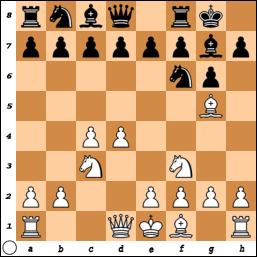 [ 5.Bg5...]
I always continued in standard fashion with the idea to play the thematic, and eventual e5, but this turns out not to be the best way of playing against it.
What to play then ? The answer is simple. When playing against the Smyslov Variation as Black, do as the great man did himself, and play the Smyslov Defence !
This involves not forcing e5, but rather playing an early c5 ( which is a standard move in the King's Indian, just not the way I play it ) and then Bf5.
This allows Black to play Ne4, and also covers b1 and on many occasions allows an attack versus the b2-pawn.
Since this is a recent discovery for me (thanks to "Starting Out: King's Indian" and Joe Gallagher), I have only played this once. A loss, but more on account of my ineptitude and lack of skill, than anything else. As in much of chess knowledge, the Master presents the ideas and we attempt to interpret and execute them successfully.
Anyway, presented below are two games. The first is from the Donner Memorial Tournament in 1994 with Smyslov as Black playing his own defence against his own invention ! Naturally, he wins.
The other is an example from 2001 of Black trying to force e5, White meeting it with Rd1, and eventually winning.
10 February, 2010
ICC Monthly Tournament (Feb 2010 ) Round 2
An enjoyable win.
I was ahead a pawn by move 9 after a slip by White...
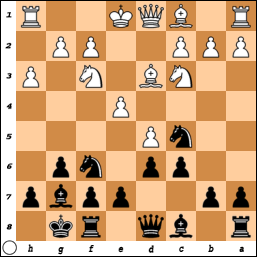 [ White plays 9.Be2 ]
...following which I generated what I thought was a good attack.
However, with 12...Ng3, I mis-calculated the various options and although I went up another pawn soon after with a mistake by White, I allowed a nasty Bh6 which cramped me.
Yet again, I spent far too much time thinking, and by this time ( move 18 ) only had about 10 minutes left.
Mistakes on both sides follow, but despite what seems like a dangerous king-side attack from White (with a Bishop on h6, and a Queen not far behind ), I found the correct moves and never really felt threatened by the attack, much more by my own time-trouble.
33.Re7 seemed good, but was a blunder, and even though I lost the exchange there, White's bishop prevented his Queen from making any check threats.
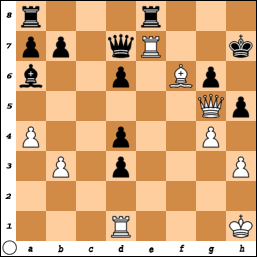 [White has played 33.Re7 ]
After 33...Rxe7 34.Bxe7, the natural check 34...Qc6 was wrong, and better was 34...Re8 35.Re1 d2 which would have finished it. If I had more time, I think White would have resigned.
I managed to get away with 35...Qc2+, which should have been answered with Rd2.
Finally, I missed an obvious mate at move 38, but won it in the end, mainly because, even though White had a huge amount of time compared to me, he played too quickly.
Interestingly, this was the first "1.d4" game I have played on ICC at standard, and despite my attempts to force it into e4 territory, it turned out into an unfamiliar, and thought-provoking, King's Indian
I am looking forward to next week, when I should have White ( & probably a higher-rated opponent ).